
- Paintball Apparel
- Accessories
- Arm Bands
- Arm Warmers
- Back Packs
- Bandana & Head Bands
- Denim Headbands
- Banners
- Barrel Covers
- Paintball Barrel Swabs
- Barrel Sleeves/Bands
- Beanies
- Embroidered Badges
- Chenille Patches
- Blank Patches
- PVC Patches
- Night Glow Patches
- Sublimated Patches
- Sublimated Key Chains
- PVC Key Chains
- Goggle Bags
- Headwraps
- Shemagh
- Pods
- Pod Bags
- Duffle Bags
- Tactical Vests
- Wallets
- Paintball Gloves
- Tactical Gear
- Tactical Backpacks
- Tactical Beanies
- Tactical Belts
- Tactical Caps
- Tactical Face Covers
- Tactical Gloves
- Tactical Gun Bags
- Tactical Gun Holsters
- Tactical Harness
- Tactical Jackets
- Tactical Jerseys
- Tactical Pants
- Tactical Pouches
- Tactical Protective Pads
- Tactical Radio Pouches
- Tactical Shemaghs
- Tactical Shirts
- Tactical Vests
- Airsoft Gear
- Casual Wears


Paintball Apparel for Women: Why the Industry Is Still Getting It Wrong — and What the Market Deserves


The women’s paintball apparel market is broken by design — literally. Most brands sell resized men’s gear instead of building apparel around the female body. Women now make up an estimated 25–30% of recreational paintball participants globally, yet purpose-built gear for them barely exists. This article breaks down the biomechanical failures, the financial opportunity brands are ignoring, and what a truly purpose-built women’s paintball line should look like.
The Day My Gear Betrayed Me Mid-Game
Let me take you to a scenario every female paintball player knows too well.
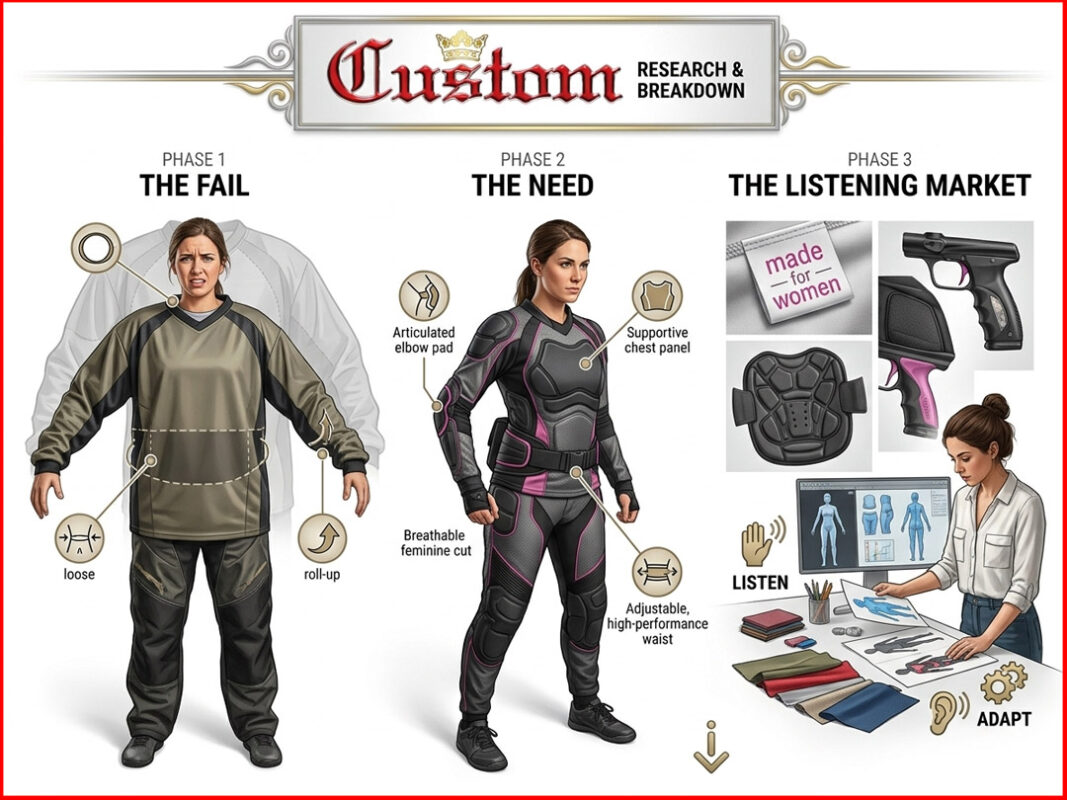
You have just survived the first wave. Adrenaline is pumping. You sprint to the left bunker, drop into a low slide — and your jersey rides up, your chest padding shifts to your armpit, and your pants gap at the hip. You take a hit at point-blank range. Not because your opponent was faster. Because your gear was not built for your body.
That moment does not just sting on the skin. It stings because you bought that kit specifically for protection.
This is the daily reality for millions of female paintball players worldwide. And yet, when you walk into most paintball retail stores or browse the top brands online, you are presented with two options: a men’s jersey in pink, or a men’s jersey in purple. Maybe a floral pattern if you are lucky.
That is not women’s paintball apparel. That is a marketing afterthought.
This article is a detailed, honest examination of why the women’s segment of the paintball apparel market is failing — and why fixing it is one of the biggest untapped opportunities in the action sports industry right now.
Section 1: The Current State — Shrink It and Pink It
What ‘Women’s Paintball Gear’ Usually Means
Walk through any major paintball apparel catalog. Sort by gender. What you will find is not a separate design language. It is a color swap.
The dominant strategy in women’s paintball apparel is called ‘shrink it and pink it’ — an industry-wide practice of taking a men’s template, reducing the measurements proportionally, adding a feminine colorway, and calling it a women’s product. It is a lazy shortcut that would not survive in serious athletic wear markets, yet it dominates paintball.
Here is why that approach fails on every performance level.
The Biomechanical Problem
Men and women have fundamentally different body geometries. This is not opinion — it is physiology. The key differences that matter for paintball apparel include:
- Shoulder-to-hip ratio: Women typically have narrower shoulders relative to hip width. A jersey scaled down from a men’s template will gap at the shoulders while pulling tight across the hips.
- Torso length: Female torsos are proportionally shorter between the shoulder and the hip. A men’s jersey scaled to a smaller chest measurement will still be too long in the torso, causing bunching, ride-up, and binding.
- Chest geometry: Women require a curved chest seam or panelled chest construction. A flat-panel men’s chest creates pressure points, restricts breathing during physical exertion, and causes padding to shift out of position.
- Waist-to-hip drop: Women’s pants need a different waist-to-hip ratio to prevent the notorious ‘gap at the back waistband’ problem that exposes the lower back during crouching or diving moves.
- Thigh circumference: Women carry more mass through the thigh relative to their waist. A pant scaled for a male body will be tight at the thigh and loose at the waist simultaneously.
None of these issues are solved by changing the size label. They require an entirely different pattern block from the very first sketch.
What the Industry Says vs. What Players Experience
Talk to any woman who has played competitive paintball for more than a season and you will hear the same complaints: jerseys that ride up mid-sprint, chest padding that migrates into the armpit, pants that gap at the lower back, and waistbands that dig in during prone positions.
These are not comfort preferences. These are performance failures. Ill-fitting gear creates distraction, reduces range of motion, and — critically — does not protect the body the way it was designed to.
A chest pad sitting in the wrong position is not protecting your chest. A hip pad that has shifted is not protecting your hip. When paintball apparel does not fit, it does not work.
Section 2: The Numbers — The Market Brands Are Ignoring
Women Are Playing. The Data Proves It.
The common assumption in paintball circles is that women are a niche within a niche. That assumption is outdated and increasingly expensive for brands that hold onto it.
Consider the participation data:
| Metric | Estimate / Finding |
|---|---|
| Female recreational paintball players (global) | Approx. 25–30% of total player base |
| Growth in female tournament registrations (2019–2024) | Estimated 18–22% increase |
| Women-focused paintball leagues launched since 2020 | Multiple regional/national leagues in US, UK, Australia |
| Female players who report difficulty finding well-fitting gear | Reported as a top barrier in community surveys |
| Average annual spend on paintball apparel (serious player) | $200–$600+ USD per year |
Even at the conservative end of these numbers, the math is stark. If a serious female paintball player spends $300 per year on apparel, and there are — conservatively — 500,000 active female players globally who are underserved by current product lines, that is a $150 million annual market with no credible product to claim it.
The brands are not failing to see this market because it does not exist. They are failing to see it because they have never bothered to look.
The Barrier to Entry Problem
Here is the hidden cost of bad gear that no brand marketing report captures: women quit the sport.
Not because they do not enjoy paintball. But because the physical discomfort of ill-fitting gear — combined with the social friction of being a minority in a male-dominated sport — creates a barrier that many players simply do not clear.
Retention is where the real revenue lives. A player who stays in the sport for five years will spend multiples more than one who tries it twice and gives up. Poor apparel design is directly contributing to female player churn.
Section 3: Design Differences That Actually Matter
What a Purpose-Built Women’s Paintball Jersey Needs
Let us get specific. These are the design differences that separate a genuinely engineered women’s paintball jersey from a resized men’s cut.
| Design Element | Men’s Standard Approach | What Women’s Design Requires |
|---|---|---|
| Chest seam construction | Flat front panel | Curved seam or darted panel for chest room without baggage at the torso |
| Shoulder width | Scaled proportionally from men’s | Independently patterned — typically 15–20% narrower at shoulder vs. equivalent chest size |
| Torso length | Scaled proportionally | Shortened between shoulder and waist — reduces ride-up by 30–40% |
| Armhole shape | Deep, straight cut | Higher, contoured cut to prevent armhole gaping during arm extension |
| Chest padding placement | Standard chest-height horizontal | Angled downward and contoured — follows natural chest geometry |
| Collar construction | Standard ribbed crew | Slightly lower front with equal or higher back — reduces neck restriction without exposing skin |
| Sleeve length/taper | Scaled from men’s | Independently measured — wrist-to-shoulder length differs significantly |
What a Purpose-Built Women’s Paintball Pant Needs
The pant is where the design gap is arguably most damaging. The lower body differences between male and female anatomy require a fundamentally different approach to pattern-making.
- Rise and waistband: Women’s hips are wider relative to waist. A standard men’s rise creates the infamous gap at the back waistband. Women’s paintball pants need a higher or contoured rise that closes this gap without restricting movement.
- Hip-to-thigh ratio: Women need additional room through the hip and upper thigh without adding bulk at the knee. Tapered thigh construction with independent hip panelling solves this.
- Seat seam: The seat seam needs to sit lower and follow a curved line rather than a straight horizontal cut — directly reduces restriction during the deep squat and low-slide positions common in paintball.
- Knee pad placement: Women’s knee joints sit at a different height relative to total leg length. Knee pads on a men’s pant fall 2–4 centimetres too low on most women, meaning protection is sitting on the shin rather than the knee.
- Calf and ankle taper: Women typically have a smaller calf circumference at the same waist size. The standard calf taper produces bunching that catches on boots and reduces agility.
Fabric Weight and Padding Density
Female players also report different sensitivity thresholds. This is relevant for padding specification.
Standard paintball apparel uses a uniform padding density across the jersey and pant. A purpose-built women’s line would tier padding weight: higher density at the chest, hip, and thigh — areas where women receive more direct hits due to wider stance — and lighter density at the shoulder and sleeve, where excess material restricts movement.
This is not a concession to fragility. It is intelligent engineering based on where impacts actually land.
Section 4: Who Is Filling the Gap — Community Brands vs. Established Players
The Established Players: A Study in Missed Opportunity
The major paintball apparel brands — the ones with the tournament sponsorships, the retail shelf space, and the marketing budgets — have largely treated the women’s market as a colour-and-sizing exercise.
This is not a new observation. Female players have been voicing this complaint in forums, social media groups, and at tournaments for over a decade. The response from established brands has ranged from token women’s collections (three SKUs in pastel colourways) to nothing at all.
The reasons are understandable from a business risk perspective. Creating a truly separate pattern block for women’s paintball apparel requires significant investment in design, testing, and production tooling. For brands already operating on thin margins in a niche sport, that capital outlay is hard to justify without clear demand signals.
The irony is that the lack of good product is suppressing the very demand signal they are waiting for.
Community-Driven Brands: Getting It Right
Into this vacuum, a number of smaller, community-rooted brands and custom apparel providers have stepped. They lack the marketing budgets of the established players but they have two things those players do not: direct relationships with female players, and the flexibility to prototype and iterate quickly.
Companies like custompaintball.co have built businesses around the idea that teams — including women’s teams — deserve apparel designed around their needs, not retrofitted from a template. Custom sublimation printing, made-to-measure sizing options, and panel-level design control allow female players and team managers to specify exactly what they need.
This is not a perfect solution. Custom gear is more expensive per unit and typically requires minimum order quantities that individual players cannot meet. But it represents the direction of travel. The data-gathering that community brands are doing with their female customers — the fit feedback, the use-case data, the repeated purchase behaviour — is exactly the intelligence that established players would need to develop a credible women’s line.
What the Athletic Apparel Industry Already Knows
Paintball is not the first action sport to make this mistake and then correct it. Road cycling, mountain biking, climbing, and trail running all went through nearly identical cycles.
In each case, the pattern was the same: male-dominated sport ignores female players, female players create grassroots demand, small brands serve that demand, large brands acquire or imitate the small brands, the market expands significantly. The paintball industry is currently sitting somewhere between steps two and three.
The athletic apparel industry’s lesson is clear: brands that moved early into purpose-built women’s technical apparel captured disproportionate brand loyalty. That loyalty compounded. Female players who felt seen by a brand became its most vocal advocates.
Section 5: What a Purpose-Built Women’s Paintball Apparel Line Should Look Like
The Blueprint
This is the section for brand decision-makers, designers, and any investor currently looking at the action sports apparel space. Here is what a genuinely competitive women’s paintball apparel line requires — not as aspirational marketing, but as engineering specification.
Step 1: Start With a Female Pattern Block
Do not scale from a men’s block. Start with a women’s athletic base block — the kind used in high-performance cycling or trail running — and adapt it for paintball’s specific requirements. This means independent shoulder, chest, torso, hip, and thigh measurements collected from a diverse sample of female paintball players across multiple regions.
Size inclusivity matters enormously here. The female paintball player population spans a wide range of body types. A women’s line that only fits a narrow range of sizes will reproduce a different version of the same exclusion problem.
Step 2: Design for Movement, Not Modesty
Paintball requires extreme range of motion: sprinting, diving, low crawling, squatting behind bunkers, and rapid direction changes. Every design decision should be stress-tested in motion, not on a mannequin.
This means:
- Four-way stretch fabric panels at high-movement zones: underarm gussets, inner thigh, back of knee
- Articulated seat seam that allows deep squat without restriction
- Flat-lock stitching at all seam points that contact the skin under pressure
- Elastic waistband with silicone grip strip to prevent jersey ride-up during dives
- No decorative elements — embroidery, heavy screen print, or raised transfers — at contact points
Step 3: Rethink Padding Architecture
Padding in women’s paintball apparel should be engineered around female anatomy. This means:
- Chest protection: curved EVA foam panels contoured to sit flush against the chest wall, not against a flat panel — eliminates the common problem of padding sitting proud and creating a pressure point rather than distributing impact
- Hip padding: wider lateral panels that sit at the correct height for women’s iliac crest — hip impacts in paintball are common and the hip bone sits differently relative to the waist in female anatomy
- Knee pad placement: knee pad pockets positioned 2–3 cm higher than the men’s equivalent to account for the proportional difference in lower leg length
- Shoulder: lighter density padding — women’s shoulders are narrower and more sensitive to bulk — combined with a shaped pad that follows the deltoid contour without restricting arm extension
Step 4: Build a Feedback Loop
The brands getting women’s technical apparel right in other sports do not get it right on the first iteration. They get it right because they have systematic feedback loops with their female customer base.
For a paintball brand entering this space, this means: fit panels with competitive female players before launch, beta testing at women’s tournaments and leagues, structured post-season surveys tied to specific design elements, and a genuine willingness to iterate rather than defend the first design.
Step 5: Market It With Respect
This sounds obvious. It is apparently not.
Marketing women’s paintball apparel should show women playing paintball — aggressively, competitively, in real game situations. Not posing. Not decoratively. Playing.
The female players who make up that 25–30% of the market are not looking for gear that makes them look cute on the field. They are looking for gear that makes them harder to eliminate.
Any brand that markets to that reality will find an audience that is not just willing to buy, but willing to evangelize.
Section 6: Buying Guide for Women Right Now
What to Look for When Shopping for Women’s Paintball Apparel Today
While the market catches up, female players still need to gear up. Here is a practical guide for making the best purchasing decisions available right now.
| What to Check | What to Look For | Red Flag |
|---|---|---|
| Jersey cut | Mentions of ‘women’s specific’ pattern or ‘athletic women’s fit’ | Only mentions size range (XS–XL) with no fit description |
| Chest construction | Darted or panelled chest seam | Flat front panel on any jersey labelled ‘women’s’ |
| Pant rise | High-rise or ‘contoured rise’ for women | Identical rise measurements to men’s equivalent size |
| Knee pad position | Adjustable or women’s-specific knee pocket placement | No mention of knee pad placement in specifications |
| Padding description | Tiered density or zoned padding | Generic ‘foam padding’ with no placement detail |
| Return/exchange policy | Generous fit-based returns | Final sale on all apparel — no fit guarantee |
| Custom options | Sublimation custom or made-to-measure available | No customisation options at all |
A Note on Custom Paintball Apparel
For team orders or players with specific fit requirements, custom sublimation apparel remains the most reliable route to gear that actually fits. Providers such as custompaintball.co offer the ability to specify panel dimensions and colour design independently — which, when used with accurate body measurements, can produce a result that off-the-shelf women’s options cannot match.
The trade-off is cost and minimum order quantity. For competitive teams, the investment is worthwhile. For individual players, the secondhand market for custom gear in women’s sizes is growing — worth exploring through team social groups and paintball forums before buying retail.
Frequently Asked Questions
Q1: Is there actually a difference between men’s and women’s paintball apparel, or is it just marketing?
In most cases on the market today, the difference is primarily marketing — different colours and smaller sizes. Genuine women’s-specific paintball apparel, with independently patterned cuts, is rare. That is exactly the problem this article is addressing.
Q2: What size should I buy if I am between standard sizes?
For most current women’s paintball apparel, size up at the chest and plan to manage the excess material at the torso. Avoid sizing up at the waist if your pant has limited elastic adjustment — excess waist material tends to bunch and restrict movement more than a snug waist. When in doubt, contact the brand directly and ask for chest, torso length, and hip measurements in centimetres — do not rely on S/M/L labels alone.
Q3: Are there women-only paintball tournaments where I can find gear recommendations?
Yes. Women’s divisions and women-only events exist at regional and national levels in the US, UK, Australia, and parts of Europe. These events are excellent sources of peer-to-peer gear recommendations from players who have tested what actually works on the field. Online communities, particularly women’s paintball Facebook groups and Reddit communities, maintain ongoing discussions about the best current apparel options.
Q4: How do I measure myself correctly for custom paintball apparel?
The four critical measurements for women’s paintball apparel are: chest circumference (fullest point), natural waist, hip circumference (fullest point, typically 8–10 inches below natural waist), and torso length (nape of neck to natural waist, taken down the centre back). Take all measurements in fitted base-layer clothing, not over loose fabric. If you are ordering as part of a team, have a second person measure you — self-measurements at the back of the neck are notoriously inaccurate.
The Market Deserves Better — and Better Is Possible
The women’s paintball apparel market is not a side issue. It is a core design failure with real financial consequences for brands and real performance consequences for players.
Female players are on the field. They are competing, improving, and spending money. They deserve apparel designed for their bodies — not apparel designed for someone else’s body and coloured to match.
The blueprint for what that looks like exists. The athletic apparel industry has already built it in cycling, climbing, and trail running. The female player base has already demonstrated its willingness to pay for it. The only missing ingredient is the decision by an established brand — or an ambitious new entrant — to build it.
Until that product exists at scale, the most practical advice for female players is: demand better. Ask brands for fit specifications. Return gear that does not fit your body correctly. Support the community brands and custom providers who are doing the work. And keep talking about this, loudly — because the brands are listening, even when they pretend they are not.
The women’s paintball apparel market deserves a revolution. It is overdue.
👉 Ready to complete your team’s look beyond the paintball field? Head over to USATEAMWEAR.COM for a wide selection of custom team apparel, including soccer jerseys, basketball jerseys, casual wear, and more!
