
- Paintball Apparel
- Accessories
- Arm Bands
- Arm Warmers
- Back Packs
- Bandana & Head Bands
- Denim Headbands
- Banners
- Barrel Covers
- Paintball Barrel Swabs
- Barrel Sleeves/Bands
- Beanies
- Embroidered Badges
- Chenille Patches
- Blank Patches
- PVC Patches
- Night Glow Patches
- Sublimated Patches
- Sublimated Key Chains
- PVC Key Chains
- Goggle Bags
- Headwraps
- Shemagh
- Pods
- Pod Bags
- Duffle Bags
- Tactical Vests
- Wallets
- Paintball Gloves
- Tactical Gear
- Tactical Backpacks
- Tactical Beanies
- Tactical Belts
- Tactical Caps
- Tactical Face Covers
- Tactical Gloves
- Tactical Gun Bags
- Tactical Gun Holsters
- Tactical Harness
- Tactical Jackets
- Tactical Jerseys
- Tactical Pants
- Tactical Pouches
- Tactical Protective Pads
- Tactical Radio Pouches
- Tactical Shemaghs
- Tactical Shirts
- Tactical Vests
- Airsoft Gear
- Casual Wears


Custom Paintball Pants — Strategic Brand Asset Guide

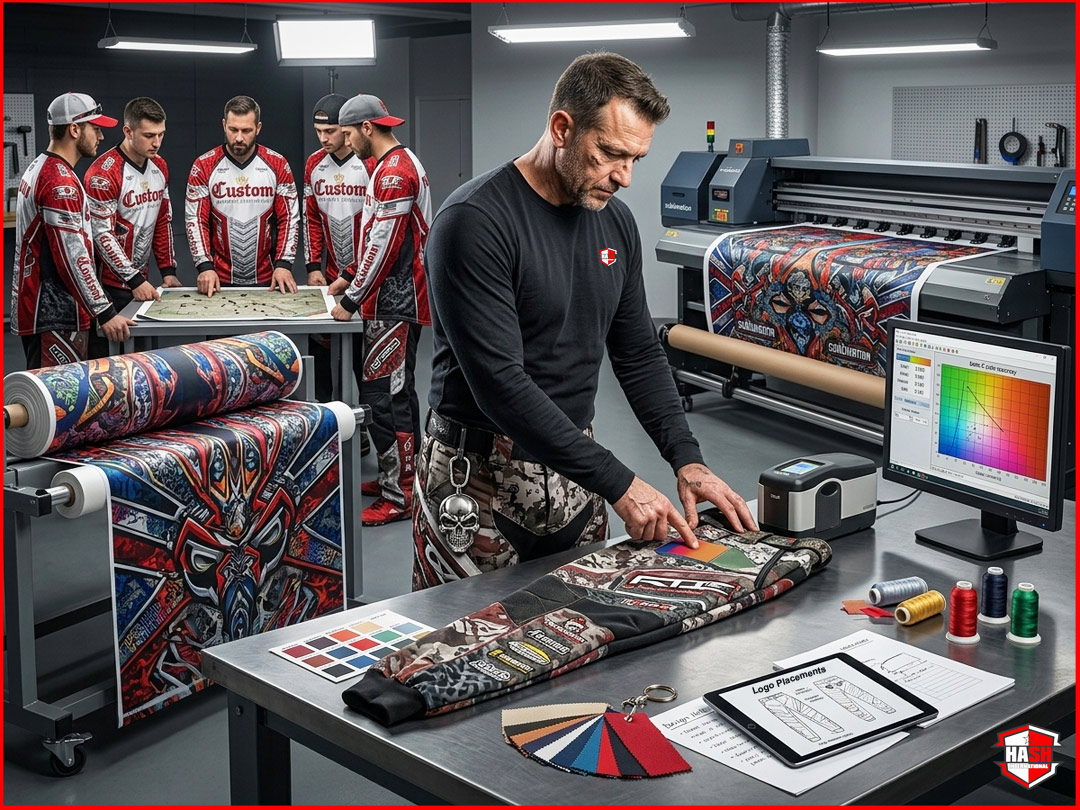
Custom Paintball Pants as a Strategic Brand Asset: What Your Uniform Is Saying Before You Fire a Single Shot
Your custom paintball pants are not a uniform. They are a performance tool, a psychological weapon, and a brand platform — all sewn into a single garment.
Teams that treat custom pants as a branding afterthought consistently leave competitive advantages unclaimed. The color you choose affects how opponents perceive your team. The print quality of your sublimation affects how sponsors evaluate your credibility. The placement of your logos affects how long those logos last on the field.
This article covers the full strategic picture: the science of why what you wear changes how you play, how to weaponize color for your field type, what Delta-E tolerances mean for your brand identity, and exactly how to manage sponsor placements without destroying your gear.
Read this before you place your next custom order. It will change what you ask for.
A Story From the Sideline
I remember standing at the edge of a speedball field at a regional qualifier about nine years ago. Two teams were warming up. One wore mismatched practice jerseys — different shades, different brands, numbers hand-stenciled on the back. The other wore identical, razor-sharp custom sets: matching pants, jerseys, and pod packs in a deep navy and electric yellow colorway with crisp sublimated sponsor logos.
Before a single paintball flew, every spectator already had an opinion about which team was more dangerous.
The team in mismatched gear wasn’t bad. They placed third. But they were fighting an uphill psychological battle from the moment they walked onto the tape. The other team — the navy and yellow squad — moved with a visible confidence. They communicated faster. They made decisions with less hesitation. And when they made a mistake, they recovered with more composure.
I asked their captain about it afterward. He said something I’ve never forgotten:
“When we put on the uniform, we become the team. Not a group of guys. The team.”
That’s enclothed cognition. And it’s the foundation of everything this article is about.
Part One: The Psychology — Why What You Wear Changes How You Play
What Is Enclothed Cognition?
Enclothed cognition is the systematic influence that clothing has on the wearer’s psychological processes.
The term was formalized by researchers Hajo Adam and Adam Galinsky in a 2012 study published in the Journal of Experimental Social Psychology. Their work demonstrated that wearing a lab coat — when associated with attentiveness and precision — caused participants to perform measurably better on tasks requiring sustained focus.
The garment didn’t make them smarter. The garment activated the mental associations linked to what the garment represented.
In competitive paintball, the implications are direct and significant.
How Custom Paintball Pants Trigger the Effect
When a player puts on a full custom uniform — particularly pants that match the team identity — several cognitive shifts happen simultaneously:
- Identity shift. The player stops thinking as an individual and begins thinking as part of a unit. Decision-making becomes less self-referential and more tactically collective.
- Competence priming. A well-made, professional-looking uniform activates associations with preparation and seriousness. The player subconsciously adjusts their behavior to match the standard the uniform implies.
- Social commitment. Wearing a matching uniform signals mutual accountability. Players report feeling more responsible to teammates when they’re visually unified.
- Opponent perception management. The opponent’s psychological state is also influenced. A visually cohesive, professionally presented team registers as a more serious threat — before the game clock starts.
What the Research Means for Paintball Teams
The research isn’t paintball-specific. But the sport maps perfectly onto the documented mechanisms.
Paintball is a sport of split-second decisions under pressure, with heavy reliance on team communication and coordinated movement. These are precisely the cognitive domains most affected by identity-activating clothing.
Practically speaking: teams that invest in cohesive custom gear report — consistently and across competitive levels — higher pre-game confidence, faster on-field communication cadence, and quicker psychological recovery after in-game errors.
This is not superstition. It is applied cognitive science. And custom paintball pants are one of the highest-leverage places to apply it.
Part Two: Color as Tactics — The Strategic Science of Choosing Your Colorway
Color Strategy
Color choice in custom paintball pants is not a design preference. It is a tactical decision. The wrong color on the wrong field type costs you concealment, cohesion, or visual communication with teammates. Get this right before you brief your designer.
The Two Primary Field Environments
Custom paintball pants must be designed with the field environment as the primary governing variable.
| Field Type | Primary Goal | Color Logic |
|---|---|---|
| Woodsball / Scenario | Visual concealment | Earth tones, disruption patterns, low contrast |
| Speedball / Airball | Team visibility & intimidation | High contrast, bold colorways, graphic impact |
| Hyperball / Mixed | Adaptability | Neutral base with distinctive accent zones |
These aren’t arbitrary categories. They represent fundamentally different tactical requirements — and a color scheme optimized for one environment can actively hurt you in another.
Woodsball and Scenario: The Concealment Imperative
In natural-terrain fields — forests, urban scenarios, milsim environments — the governing logic of custom paintball pants color is disruption of visual silhouette.
The human eye is extraordinarily efficient at detecting solid-color shapes against natural backgrounds. A solid-olive pant worn in a mixed-green-and-brown woodland environment is actually more detectable than a well-designed disruptive camouflage pattern, because the solid shape reads as unnatural.
Effective woodsball color strategy includes:
- Earth tone base layers: Olive drab (Pantone 7497C), flat dark earth (Pantone 7530C), and ranger green (Pantone 371C) are proven baseline colors that read neutrally across most North American and European woodland environments.
- Disruption pattern integration: True disruptive patterning — not repetitive digital camo tiles — breaks the outline of the leg into visually fragmented segments. This is achieved through sublimation printing, which allows pattern complexity that no cut-and-sew process can replicate.
- Contrast suppression: Avoid any high-contrast seam lines, piping, or logo placements in bright colors on woodsball pants. A single bright accent patch defeats the concealment function of an otherwise well-designed garment.
Speedball and Airball: The Visibility and Intimidation Play
On a speedball field — bright turf, inflatable bunkers, open sightlines in all directions — concealment is irrelevant. Every player is visible to every opponent within seconds of the game clock starting.
The governing color logic shifts to two entirely different objectives:
1. Teammate Visibility In the chaos of a speedball point, instant visual identification of teammates is a speed multiplier. High-contrast colorways allow players to locate teammates in peripheral vision without breaking focus from their primary target. Deep navy against white bunkers, electric yellow against green turf, or crimson against any neutral background all serve this function well.
2. Psychological Presence Bright, high-graphic custom paintball pants project visual confidence. Research into competitive sport aesthetics consistently shows that bold, unified team presentations are perceived as more threatening by opponents — particularly in the pre-game and opening seconds of a match. This isn’t trivial. The opening seconds of a speedball point are the highest-pressure, highest-decision-density moments of competitive play. Starting those seconds with a psychological edge is a genuine tactical asset.
Example: How Color Choice Played Out in Regional Competition
At a five-man regional event I attended, two mid-tier teams were statistically evenly matched across their season records. One wore a standard black-and-grey custom set — clean, professional, neutral. The other wore a high-contrast orange and charcoal set with bold sublimated team graphics.
Over three head-to-head matches throughout the season, the orange-and-charcoal team won two of three. Post-match surveys of the black-and-grey team’s players revealed a recurring theme: they described the opposing team as “intimidating” and “well-organized” — attributing characteristics to the team that their actual skill level didn’t fully justify.
The orange pants did work that the players’ skills alone couldn’t.
Part Three: Sublimation Printing — Why Color Accuracy Is a Brand Issue, Not Just an Aesthetic One
Sublimation Color Accuracy
If the color on your custom paintball pants doesn’t match your team brand standards with scientific precision, you are not building a brand. You are producing an approximation of one. Delta-E tolerance is the metric that separates professional custom production from amateur guesswork.
What Is Sublimation Printing?
Sublimation printing is a dye-transfer process in which heat converts solid dye into gas, which bonds permanently with the polyester fibers of the fabric at a molecular level.
The result is a print that does not sit on top of the fabric — it becomes part of it. This means:
- No cracking, peeling, or flaking over time
- No texture difference between printed and non-printed zones
- Full-bleed, edge-to-edge color without seam interference
- Unlimited color complexity, including photographic gradients and fine detail patterns
For custom paintball pants, sublimation is the only printing method capable of delivering the design complexity, durability, and color vibrancy that competitive teams require.
What Is Delta-E and Why Does It Matter for Your Brand?
Delta-E (ΔE) is the numerical measurement of the difference between two colors as perceived by the human eye.
A Delta-E of 0 = identical colors. No perceivable difference. A Delta-E of 1–2 = difference detectable only by trained colorists under controlled conditions. The Delta-E of 3–5 = noticeable difference to a typical observer in a side-by-side comparison. A Delta-E above 5 = obvious color mismatch, clearly visible in normal viewing conditions.
| Delta-E Range | Perception | Acceptable For Custom Paintball Apparel? |
|---|---|---|
| 0–1 | Imperceptible | Yes — premium standard |
| 1–2 | Expert-detectable only | Yes — professional standard |
| 2–3 | Noticeable on close inspection | Acceptable for practice gear |
| 3–5 | Clearly visible side-by-side | No — brand inconsistency risk |
| 5+ | Obvious mismatch | Reject the production run |
Why This Matters Beyond Aesthetics
Consider this scenario: your team’s brand color is Pantone 286C — a specific, saturated royal blue. Your jerseys are printed by one supplier. Your custom paintball pants are printed by another. Neither supplier verified Delta-E output against your Pantone standard.
At a tournament, under natural light, your jerseys and pants are visibly different shades of blue.
To sponsors reviewing your team for potential support, this registers — consciously or not — as disorganization. Brand inconsistency is one of the clearest signals of amateur operation in professional-facing contexts.
For teams pursuing sponsorship or building a regional brand identity, Delta-E is not a technical footnote. It is a business metric.
How to Enforce Delta-E Standards in Your Custom Order
Protecting color accuracy in custom paintball pants production requires specific, verifiable steps:
Step 1: Specify colors in Pantone codes, not hex values or screenshots. Pantone codes (e.g., PMS 286C) are internationally standardized and measurable. Hex values (#003DA5) are screen-display standards with no guaranteed real-world color output. Never use screenshots, JPEGs, or “match this” references — these introduce undefined color variation at the very first step.
Step 2: Require a physical color strike-off before production approval. A strike-off is a printed fabric swatch produced before your production run. Request that the manufacturer measure the strike-off against your Pantone specification using a spectrophotometer and provide the Delta-E result in writing. Reject any strike-off with a Delta-E above 2.0 for primary brand colors.
Step 3: Verify production samples under field-representative lighting. Colors shift under different light sources. A perfect match under factory fluorescent lighting can drift noticeably in outdoor natural sunlight — the condition under which your custom paintball pants will actually be viewed. Evaluate your production sample under both indoor and outdoor lighting before approving the run.
Step 4: Document your standards for future orders. Store your approved strike-offs and Delta-E documentation for every production run. This becomes your baseline reference for reorders, and it protects you if a manufacturer delivers inconsistent quality in subsequent orders.
Part Four: Sponsor Logo Placement — The Manufacturing Constraints Nobody Tells You About
Sponsor Logos
Most teams manage sponsor logo placement on custom paintball pants as if it were a graphic design problem. It is actually a materials engineering problem. Logos placed incorrectly — in the wrong zones, with the wrong application method — fail in the field and damage sponsor relationships. Here is how to do it right.
The Three Logo Placement Zones on Paintball Pants
Every pair of custom paintball pants can be divided into three functional zones, each with different movement characteristics and appropriate decoration methods:
1: High-Flex Zones
- Inner thighs
- Behind the knees
- Seat panel
- These zones experience constant, high-amplitude stretch and compression during normal play.
2: Medium-Flex Zones
- Outer thigh panels
- Front quadriceps area
- Lower leg panels
- These zones flex during movement but don’t experience the extreme elongation of Zone 1.
3: Low-Flex Zones
- Waistband
- Hip panels
- Lower back yoke
- These zones experience minimal stretch and are closest to stable structural points of the garment.
Matching Decoration Method to Zone
This is where most teams — and many manufacturers — make critical mistakes.
| Zone | Flex Level | Correct Decoration Method | Methods to Avoid |
|---|---|---|---|
| Zone 1 (High-Flex) | High | Sublimation only | Embroidery, PVC patch, screen print |
| Zone 2 (Medium-Flex) | Medium | Sublimation, heat-transfer vinyl (HTV) | Embroidery, raised PVC |
| Zone 3 (Low-Flex) | Low | Sublimation, HTV, embroidery, woven label | Screen print on stretch fabric |
Why embroidery fails on high-flex zones: Embroidery creates a rigid structure — thread loops tightly packed across a stabilizer backing. When placed on a Zone 1 area, this rigid structure fights against the fabric’s stretch on every movement. The result is progressive delamination of the backing, thread breakage, and pilling of the surrounding fabric. A logo that looks perfect on delivery will show visible deterioration after 8–12 hours of active play.
Why sublimation is the correct method for flex zones: Sublimation dye bonds at the fiber level. There is no surface structure to crack, peel, or delaminate. The decoration flexes with the fabric because it is the fabric. For any logo or graphic element placed on a high- or medium-flex zone, sublimation is the only manufacturing-sound choice.
A Practical Sponsor Placement Example
Here is how a well-managed sponsor layout might look for a five-man speedball team’s custom paintball pants:
| Sponsor | Logo Size | Placement Zone | Method |
|---|---|---|---|
| Primary Sponsor (paintball brand) | 8cm × 5cm | Outer right thigh (Zone 2) | Sublimation |
| Secondary Sponsor (apparel brand) | 6cm × 4cm | Outer left thigh (Zone 2) | Sublimation |
| Team name/number | 4cm × 3cm | Right hip panel (Zone 3) | Embroidery or woven label |
| Minor sponsor | 4cm × 2.5cm | Lower back yoke (Zone 3) | HTV or sublimation |
| Website/handle | Text only | Lower right leg (Zone 2) | Sublimation |
This layout gives primary sponsors prominent, highly visible placement on the most visible panels during gameplay. Secondary sponsors occupy clear secondary hierarchy. Embroidery is used only where it can survive — the low-flex Zone 3 locations.
The Sponsor Conversation You Need to Have Early
One of the most avoidable mistakes in custom paintball pants production is allowing sponsors to dictate logo placement without manufacturing input.
Sponsors naturally want their logos as large and prominent as possible. That is their entirely legitimate interest. Your job, as team manager or gear coordinator, is to communicate the manufacturing constraints clearly before artwork is finalized.
The conversation should cover three points:
1. Placement governs method, and method governs durability. Explain that a logo placed on the inner thigh will fail — visibly and quickly — if produced with embroidery. This is not a design limitation. It is a materials science reality. A sponsor whose logo is visibly degraded after one tournament is a sponsor who will not renew.
2. Size on pants is governed by panel dimensions and movement geometry. A logo that is 12cm wide works perfectly on a jersey chest. That same logo on the outer thigh of custom paintball pants may overlap onto the knee panel or inner thigh, pushing it into a high-flex zone. Panel size must be confirmed before logo sizing is agreed upon.
3. Document the approved placement in writing before production begins. Create a simple placement map — even a hand-drawn sketch with measurements — that is signed off by both the team and the sponsor. This prevents disputes after delivery and ensures the manufacturer has a clear, unambiguous brief.
Part Five: Building a Multi-Season Brand Strategy Around Custom Paintball Pants
Long-Term Brand Strategy
One production run does not build a brand. Consistency across seasons, events, and product categories builds a brand. Here is how teams that take their identity seriously manage custom pants across a competitive career.
The Brand Standards Document
Every team serious about building a recognizable identity should maintain a one-page brand standards document. This does not need to be complex. It should cover:
- Primary and secondary brand colors in Pantone codes
- Approved typefaces for name and number treatment
- Logo file formats and minimum reproduction sizes
- Placement guidelines for pants, jerseys, and pod packs
- Approved manufacturers and strike-off reference samples
When this document exists, every future production run — whether for five players or twenty — starts from the same foundation. Without it, each production run introduces variation that erodes brand consistency over time.
Consistency Across the Uniform System
Custom paintball pants are one component of a visual system. They interact visually with the jersey, the pod pack harness, the goggle frame, and even the marker color scheme.
Teams with strong brand identities manage all of these elements from a single visual brief. The pants don’t need to match every element exactly — creative tension between components is legitimate design. But they must be deliberately coordinated. Accidental variation is always visible to informed observers.
Manufacturers like custompaintball.co who work across the full uniform system — pants, jerseys, and accessories — can enforce visual consistency across components in a way that sourcing from multiple uncoordinated suppliers cannot.
Planning Reorders Without Drift
One of the most common frustrations in custom team apparel is color drift between original production runs and reorders.
This happens for several reasons:
- Fabric dye lots change between production runs
- Sublimation calibration drifts on printers between sessions
- Original artwork files get modified (even slightly) between orders
The solution is rigorous documentation:
- Retain your approved production samples physically — not just digitally
- Store approved artwork in locked, versioned files that require explicit authorization to modify
- Require that reorder strike-offs are measured against original samples, not against the original artwork
If you follow this protocol, your third-season custom paintball pants will match your first-season pair closely enough that the two can be worn together without visible inconsistency.
Frequently Asked Questions
Q: Do custom paintball pants really affect performance, or is this just marketing?
The enclothed cognition research is peer-reviewed and replicable. The performance benefits are not direct — custom pants don’t make you shoot faster or move quicker mechanically. The benefits are cognitive and psychological: better focus, stronger team identity activation, faster communication, and improved psychological resilience under pressure.
Q: Can I use my existing sponsor logos in CMYK instead of Pantone for sublimation?
CMYK values can be used, but they carry more color variance risk than Pantone specifications because CMYK output is device-dependent — the same CMYK values print differently on different machines and substrates. If your sponsor has a Pantone specification for their logo color, always use it.
Q: Should our team pants match our jerseys exactly, or is some variation acceptable?
Exact match is ideal for primary colors. Some teams intentionally introduce minor accent variation between jerseys and pants — for example, a navy base with white accents on the jersey and navy base with gold accents on the pants — as a deliberate design choice. What you want to avoid is unintentional variation from inconsistent production. Deliberate design choices read as style. Accidental variation reads as disorganization.
Q: How do we brief a manufacturer on sponsor logo requirements without a design background?
Create a simple zone map: photograph a pair of pants laid flat, draw three rough circles (Zone 1: inner thigh and seat, Zone 2: outer thigh panels, Zone 3: waistband and hip), and note which sponsors belong in which zone. Specify the desired logo size in centimeters. Note the application method (sublimation preferred). This brief — even hand-drawn — gives a manufacturer 90% of what they need to quote and produce correctly.
Summary: The Strategic Checklist for Custom Paintball Pants as a Brand Asset
Before you place your next custom order, work through this checklist:
Psychology & Identity
- Have you communicated to your team what the uniform represents — not just what it looks like?
- Is your colorway deliberately chosen to activate identity and cohesion, not just to look attractive?
Color Strategy
- Have you matched your color logic to your primary field type (concealment vs. visibility)?
- Are all brand colors specified in Pantone codes?
Sublimation Quality
- Have you required a physical strike-off with spectrophotometer-measured Delta-E results?
- Have you evaluated the strike-off under outdoor lighting conditions?
Sponsor Management
- Have you mapped each sponsor logo to a Zone 1, 2, or 3 placement?
- Have you specified sublimation (not embroidery) for any logos in Zone 1 or Zone 2?
- Is placement documented in writing, approved by both team and sponsor?
Long-Term Brand Consistency
- Do you have a brand standards document with Pantone codes and placement rules?
- Are your original production samples stored for reorder reference?
- Are your artwork files version-locked against unauthorized modification?
Final Thought
The team in navy and yellow that I watched at that regional qualifier nine years ago didn’t win the tournament because of their pants. They won — in part — because their pants helped them believe they would. And they gave every opponent a reason to doubt themselves before the first bunker break.
That is what a strategic brand asset does. It works before you do.
Custom paintball pants — designed with intention, produced with precision, and managed with the discipline of a real brand — do exactly that. Whether you’re competing at a local rec field or building toward national circuit play, the investment in getting this right returns more than aesthetics.
It returns a competitive edge. Every time you suit up.
