
- Paintball Apparel
- Accessories
- Arm Bands
- Arm Warmers
- Back Packs
- Bandana & Head Bands
- Denim Headbands
- Banners
- Barrel Covers
- Paintball Barrel Swabs
- Barrel Sleeves/Bands
- Beanies
- Embroidered Badges
- Chenille Patches
- Blank Patches
- PVC Patches
- Night Glow Patches
- Sublimated Patches
- Sublimated Key Chains
- PVC Key Chains
- Goggle Bags
- Headwraps
- Shemagh
- Pods
- Pod Bags
- Duffle Bags
- Tactical Vests
- Wallets
- Paintball Gloves
- Tactical Gear
- Tactical Backpacks
- Tactical Beanies
- Tactical Belts
- Tactical Caps
- Tactical Face Covers
- Tactical Gloves
- Tactical Gun Bags
- Tactical Gun Holsters
- Tactical Harness
- Tactical Jackets
- Tactical Jerseys
- Tactical Pants
- Tactical Pouches
- Tactical Protective Pads
- Tactical Radio Pouches
- Tactical Shemaghs
- Tactical Shirts
- Tactical Vests
- Airsoft Gear
- Casual Wears


Custom Paintball Harness Manufacturing Guide

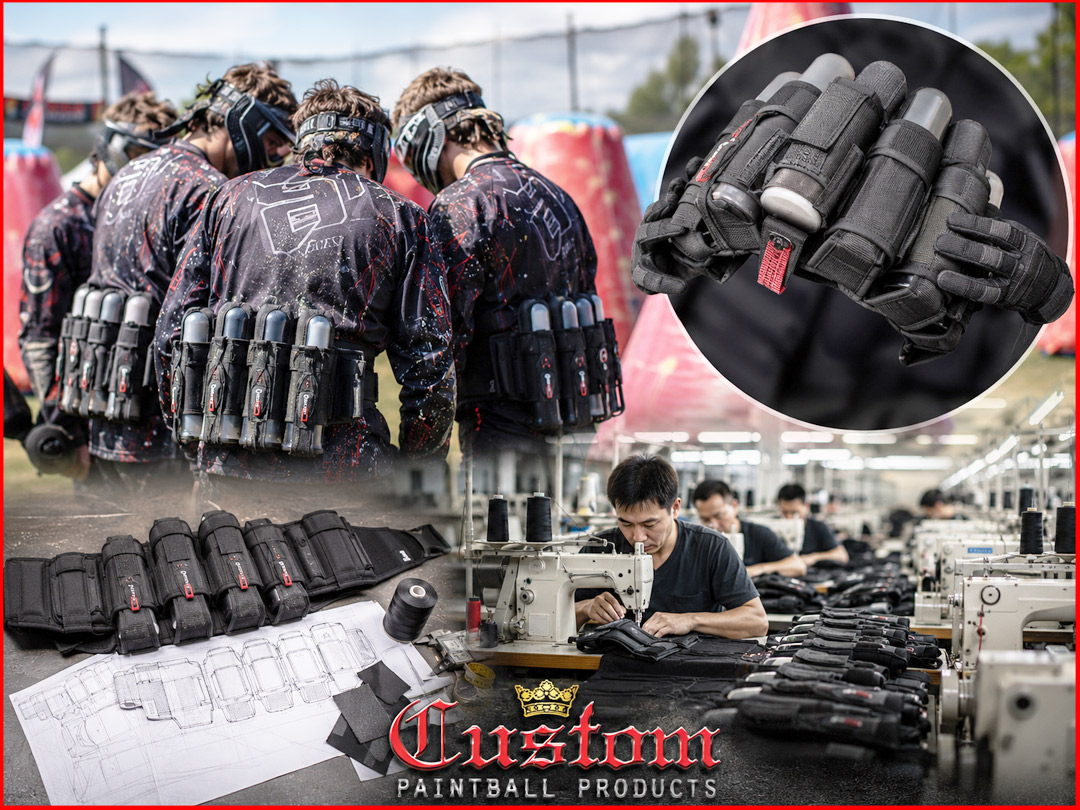
Custom Paintball Harness Manufacturing: Why Teams Are Bypassing OEM Brands and Going Direct to Cut-and-Sew Facilities
Competitive paintball teams — from regional squads to NXL rosters — are increasingly bypassing established OEM brands and ordering custom paintball harness direct from cut-and-sew manufacturers. The reasons are practical, financial, and technical.
Minimum order quantities have dropped below 12 units at many overseas facilities. Prices now undercut branded OEM gear. And the customization available — precise elastic tension, exact pod angles, bespoke back-panel widths — simply cannot be matched by any off-the-shelf product.
But this shift is not without risk. Fabric substitution, thread-grade cutting, and inconsistent die-cut tolerances are real problems in unvetted production. This article tells you everything you need to know before your team makes the jump.
The Story Behind the Shift
It was 2023. Our team had just made it to the regional finals for the third year running. We were fast. We were dialed in. But every time we hit the snake, the same problem surfaced: the harness.
Pods were shifting mid-sprint. The back panel was soaked after the first point. One player’s belt attachment pulled loose during a reload drill. We were running a $140 branded harness from a well-known OEM — and it was letting us down in ways that felt embarrassing given the price tag.
Our equipment manager made a call to a cut-and-sew facility custompaintball.co. Four weeks later, we had 12 custom paintball harnesses on our doorstep. Same price per unit. Better construction. Built to our exact specifications.
That was the moment I understood why the industry was changing. And three years on, what was once a whisper among competitive teams has become a fully visible trend reshaping paintball apparel manufacturing.
Section 1: The Minimum Order Quantity Revolution
How Small-Run Overseas Manufacturers Changed the Game
For years, custom manufacturing was reserved for the elite. Large teams. Sponsored squads. National-level organizations with budgets to match. The barrier was always minimum order quantity (MOQ).
A branded OEM might produce harnesses in runs of 500 or 1,000 units. If you wanted a custom version — even a minor spec change — you were looking at matching that volume. For most recreational and semi-competitive teams, that was a dead end.
What Has Changed Since 2020
Several converging forces have compressed MOQ requirements dramatically at overseas cut-and-sew facilities:
- Lean manufacturing adoption in Southeast Asian and South Asian factories has made short-run production economically viable.
- Digital pattern-making software eliminates the expensive physical pattern creation step, reducing setup costs.
- B2B platforms like Alibaba, Made-in-China, and direct factory outreach via trade fairs have increased competition between small manufacturers, pushing MOQs down.
- Excess factory capacity left by large Western brand buyers is now being filled by smaller clients with short-run orders.
The result is stark. In 2019, a typical MOQ for a custom paintball harness from a credible overseas manufacturer was 100 to 200 units. By 2024, teams are successfully ordering as few as 12 to 24 units with full custom specs, embroidery, and sublimated printing at competitive per-unit pricing.
“We ordered 15 harnesses with custom elastic spec, team sublimation, and our own buckle placement for less than we were spending on branded product. The quality was identical — arguably better on the seam work.” — Regional NXL competitor, 2024
The Real Cost Comparison
| Factor | Branded OEM Harness | Custom Cut-and-Sew |
|---|---|---|
| Average unit price (mid-tier) | $110 – $160 | $55 – $95 |
| Minimum order quantity | N/A (retail single unit) | 12 – 50 units |
| Spec customization | None | Full |
| Lead time | In stock / 3–5 days | 2 – 6 weeks |
| Branding / sublimation | Not available | Included at volume |
| Fabric substitution risk | Low (known brands) | Moderate (vetting required) |
The numbers tell a clear story. For a team buying 15 harnesses, the savings on a custom order versus branded OEM retail can range from $225 to $975 depending on spec level. That gap funds entry fees, travel, or additional equipment.
Section 2: What Teams Actually Customize
It Goes Far Beyond Putting Your Logo on a Harness
Here is where most people misunderstand the custom paintball harness trend. They assume teams are doing this for aesthetics — putting their name and colors on an otherwise standard product.
That does happen. But experienced teams going direct to manufacture are doing something fundamentally more interesting: they are engineering their gear.
Below are the most impactful functional customizations competitive teams are requesting — and why each one matters to performance.
1. Elastic Tension and Retention Spec
Pod retention in a paintball harness is governed by elastic sleeve tension. Stock harnesses use a single elastic spec across the full harness. This creates a compromise. The tension that holds pods securely during a full sprint is often tight enough to slow retrieval under pressure.
Custom orders allow teams to specify different elastic weight across individual pod sleeves. Top-reload pods get stiffer retention. Side-access pods get lighter tension for faster single-motion pulls. This is not possible with any standard retail product.
2. Pod Angle and Placement Geometry
The angle at which a pod sits in its sleeve determines how your body rotates to access it. For a right-handed player reloading left pods, the ideal extraction angle differs from a player who reloads while prone versus standing.
Direct manufacturing allows teams to specify pod sleeve angle in degrees. A 15-degree forward tilt versus a straight vertical placement can reduce reload time by fractions of a second — which at competitive level is the difference between a point won and a point lost.
Some teams spec different angles for right-side and left-side pods based on their player positions and dominant hands. No branded product offers this.
3. Back-Panel Width and Height
The back panel of a paintball harness carries the bulk of the load — especially when running 8-pod setups. A panel that is too wide sits into the shoulder blades during low-crawl movement. Too narrow, and pod weight distribution concentrates on the lumbar rather than the hip shelf.
Custom manufacturing allows teams to specify back-panel dimensions to the centimeter. Tall players with longer torsos need more vertical panel coverage. Compact players benefit from a lower center of gravity on the panel. These are not aesthetic decisions — they are biomechanical ones.
4. Belt Attachment Points and Hip Architecture
Where and how the harness belt attaches to the main body panel directly affects how the entire assembly moves with the player. Factory-standard attachment points are centered on a universal body template. Players with athletic builds, wider hip structures, or non-standard torso ratios find these attachment points create torque during lateral movement.
Teams going direct to manufacture are specifying attachment point placement based on their players’ actual measurements. Some are also requesting reinforced anchor zones using double-layered base fabric — a construction upgrade that adds minimal cost at production stage but dramatically extends the working life of the harness under competitive use.
5. Material Specifications
Custom orders also allow teams to specify base fabric — typically a choice between 500 denier Cordura, 420D ripstop nylon, or ballistic nylon blends. Each carries a different weight-to-durability ratio and responds differently to moisture and abrasion.
- 500D Cordura: heavier, maximum abrasion resistance, preferred for woodsball and scenario play
- 420D Ripstop: lighter, faster-drying, preferred for speedball and tournament play
- Ballistic nylon blends: mid-weight option with enhanced tear resistance along seam lines
Stock OEM harnesses rarely disclose their fabric spec at this level of detail. Custom orders put that decision in the team’s hands.
Section 3: Quality Control Risks You Must Understand
The Price of Getting This Wrong Is Paid on the Field
Here is the part of the custom paintball harness story that does not get enough attention. The same factors that make direct manufacturing attractive — reduced cost, flexible MOQ, accessible ordering — also create real quality control vulnerabilities if you are not careful.
Teams that receive orders where what they specified and what arrived are two different products are not always victims of dishonesty. Sometimes it is simply that the quality control systems established brands spend years building are not present in every small-run facility.
Risk 1: Fabric Substitution
This is the most common problem. A team specifies 500D Cordura. What arrives looks and feels similar — but tests closer to a 420D polyester blend. The difference is not visible to the naked eye. It shows up six months later when pods are wearing through sleeve walls.
How to protect yourself:
- Request a physical swatch sample before committing to a full order
- Ask the factory to provide the fabric supplier name and material datasheet
- Specify the Cordura brand by name in your order documentation — not just denier weight
- Conduct a burn test on sample material: genuine nylon burns with a hard bead and self-extinguishes; polyester blends drip
Risk 2: Inconsistent Die-Cut Tolerances
Pod sleeves are formed from die-cut fabric panels. When die-cut tolerances are loose — often the case in facilities running multiple client products simultaneously — pod sleeve dimensions can vary by several millimeters between harnesses in the same batch.
This matters because pod retention depends entirely on the relationship between sleeve dimension and pod diameter. A sleeve cut 4mm too wide on a given harness will not hold pods reliably during sprint movement regardless of elastic spec.
Request a tolerance specification in writing. A credible manufacturer should be able to hold to within 1.5mm on die-cut panel dimensions. If they cannot or will not commit to a tolerance, treat that as a red flag.
Risk 3: Thread Grade and Stitch Density
Thread grade and stitch density are the most technical quality variables — and the easiest to compromise without detection on visual inspection. Under-spec thread in high-stress seam zones (belt loops, pod sleeve anchors, back panel joins) will fail under repeated dynamic load well before the fabric does.
Industry standard for load-bearing seams in tactical and sport apparel is a minimum of 8 stitches per inch using Tex 40 or higher thread. Facilities cutting cost will use Tex 30 thread at 6 stitches per inch. The difference is invisible until a seam opens mid-game.
| Spec | Minimum Acceptable | Recommended (Competition Grade) |
|---|---|---|
| Thread grade | Tex 30 | Tex 40 or higher |
| Stitches per inch (load-bearing seams) | 7 SPI | 9–11 SPI |
| Belt loop reinforcement | Single pass | Bar-tack or box-X |
| Pod sleeve anchor stitch | Single needle | Double needle chain |
| Buckle attachment method | Sewn loop | Sewn + webbing bar-tack |
How to Vet a Manufacturer Before Ordering
- Order a single sample harness to your spec before committing to a full run. Budget $150–$200 for this. It is the best quality insurance available.
- Put your full spec in writing — fabric, thread, stitch density, tolerance requirements — as a technical spec document, not just a conversation.
- Ask for reference clients in the sporting goods or tactical apparel space and contact them directly.
- Use a freight forwarder or sourcing agent with Pakistan or China production experience if you do not have direct factory relationships.
- Review the factory’s ISO certification status. ISO 9001 does not guarantee quality, but it indicates that documented processes exist.
Section 4: Sponsorship Economics and the Revenue Angle
Why Custom Harnesses Have Become a Team Income Stream
This is the aspect of the custom paintball harness movement that surprises most people outside the competitive scene.
Teams are not just buying custom harnesses to save money or improve fit. They are buying them at manufacturing cost and building a revenue model around them.
The Sponsorship Visibility Equation
A paintball harness is the most visible piece of equipment a player wears. It covers the back, wraps the torso, and carries branding at the exact eye level of both spectators and camera angles during competition. In terms of logo real estate, it competes directly with a jersey — and it is visible in motion shots in a way that a jersey often is not.
Teams that control their harness production can sell that real estate. Local businesses, regional brands, and equipment manufacturers pay for logo placement on tournament-worn gear. A team running 15 custom harnesses across a season of regional and national tournaments is delivering hundreds of in-frame exposures per event.
Revenue Model Examples
| Model | Description | Est. Revenue |
|---|---|---|
| Sponsor logo placement | Back panel embroidered or sublimated sponsor logo, per event season | $200 – $800/sponsor |
| Limited team edition sale | Retail surplus units to fans and recreational players at markup | $35 – $60/unit margin |
| Co-branded field edition | Partner with local field for co-branded rental/retail fleet harness | $8 – $15/unit royalty |
| Custom order service | Act as sourcing intermediary for other local teams | $15 – $30/unit fee |
A team ordering 20 units at $75 each (manufacturing cost: $1,500) and carrying one back-panel sponsor at $400 per season has effectively reduced their net harness cost to $55 per unit. Add a fan edition retail sale of 10 surplus units at $110 retail, and the harnesses become net-positive for the team budget.
This is not hypothetical. Competitive teams across North America and Europe have quietly built this model into their operational budgets.
What Sponsors Are Actually Paying For
Understanding sponsor value makes the economics clearer. What a sponsor buys is not a logo on a harness — it is association with competitive performance and visible presence across multiple touchpoints:
- Tournament live streams and VOD replays
- Team social media content where harnesses appear in training and match footage
- In-person field presence at events attended by buyers in the target demographic
- Credibility transfer — a business associated with a winning team earns trust in the paintball community
Section 5: The Ripple Effect on Established OEM Brands
How Branded Manufacturers Must Respond to Survive
If you are an established paintball apparel brand watching this trend, the instinctive reaction is to dismiss it as a niche movement. That would be a strategic mistake.
The teams going direct to cut-and-sew are not fringe actors. They are the core demographic — competitive, influential, visible, and vocal. When a regional NXL team stops buying your harness and starts showing up in custom gear, that choice is noticed by the 200 recreational players at the same event who aspire to play at that level.
Where OEM Brands Are Vulnerable
The honest assessment from an apparel manufacturing perspective is that most branded paintball harnesses have not meaningfully evolved their construction in over a decade. The spec differences between a $60 harness and a $160 harness from the same brand are often cosmetic — color options, logo treatment, minor aesthetic changes to buckle style.
Meanwhile, cut-and-sew facilities are now producing to the same base construction standard at lower price points, with full customization available. The branded premium has to justify itself through something beyond the label.
The Spec Differentiation Imperative
| What OEM Brands Are Competing On Now | What They Should Be Competing On |
|---|---|
| Logo recognition and colorway options | Documented fabric specifications with transparency |
| Retail availability and fast shipping | Technical performance differentiation by player position |
| Influencer and team sponsorship visibility | Published construction standards (stitch density, seam spec) |
| Price point laddering (entry / mid / pro) | Body-geometry-specific sizing (youth, female, torso variants) |
| Aesthetics and matching jersey colorways | Modular systems (interchangeable pod configuration panels) |
The brands that will win in the next decade are those that give competitive players a reason to pay a premium that custom manufacturing cannot easily replicate. That means genuine technical innovation: modular construction systems, body-specific fit engineering, transparent material specs, and performance data behind their design choices.
It also means rethinking sponsorship strategy. Giving sponsored teams branded OEM harnesses is losing its value signal when those teams know they could get a custom-spec product for the same or lower cost. Smart brands are moving toward co-development relationships — working with competitive teams on spec design and featuring them in product development.
The Retention Play: What OEM Brands Can Still Offer
Custom manufacturing is not without friction. Lead times of 4 to 8 weeks are a real disadvantage for teams that need emergency replacements. Quality control without established relationships remains risky. And the intellectual effort required to produce a proper technical spec document is beyond most recreational teams.
Established brands that streamline access to semi-custom options — allowing spec selection from a defined menu (elastic weight, panel size, pod angle) with 2 to 3 week turnaround — could recapture a significant portion of the market moving toward custom production. That middle ground currently has no strong occupants.
Frequently Asked Questions
How many harnesses do I need to order to go custom?
The practical minimum at most credible facilities is 12 units. At that quantity, per-unit setup costs are absorbed, and sublimation printing becomes economically viable. Some facilities will go as low as 6 units for existing clients, but first-time orders below 12 are unusual.
Can I use my team’s existing harness as a pattern base?
Yes. Most factories will accept a physical sample as a pattern reference, particularly for dimensions and panel geometry. Send a physical harness with written annotations for any spec changes. This reduces back-and-forth and lowers the risk of dimensional misinterpretation from written specs alone.
What is the difference between sublimation and embroidery for harness branding?
Sublimation embeds color into the fabric fiber through heat transfer and is ideal for complex graphics, gradients, and full-panel designs. It has no texture, does not affect fabric hand, and will not peel. Embroidery is stitched lettering or logos — more tactile, more premium in feel, but limited to simpler designs and adds slight weight. Most teams use sublimation for full background designs and embroidery for team name or sponsor logo accents.
Is a custom paintball harness legal for NXL or PSP competition?
Yes. There are no equipment regulations in major paintball leagues that restrict harness construction or branding, provided the harness does not interfere with hopper or marker function. Custom harnesses that meet the same physical dimensions as standard designs are fully legal across all major formats.
This Is Not a Trend — It Is a Structural Shift
What started as a handful of competitive teams finding smarter ways to gear up has become a visible, accelerating movement in paintball apparel purchasing. The custom paintball harness is no longer a specialty item — it is an increasingly rational choice for any organized team with a minimum of 12 players.
The economics work. The quality, properly managed, matches or exceeds branded OEM product. The performance benefits of spec customization are real and measurable. And the sponsorship revenue model gives competitive teams a way to turn their gear into a financial asset rather than just a cost.
The risk is real too. Unvetted production carries genuine quality vulnerabilities. Teams that skip the sample-and-spec process pay for it in failed seams and inconsistent retention. The shift to direct manufacturing rewards preparation and punishes shortcuts.
For established OEM brands, the message is equally clear. Logo recognition and retail availability are no longer defensible moats. Technical transparency, fit engineering, and genuine performance differentiation are the ground that must be held.
The players are getting smarter about what they put on their bodies. The industry needs to keep pace.
